Advancing SDG 4: AK Ajibade Foundation’s Summer Lesson Program Leaves Lasting Impact in Alanamu
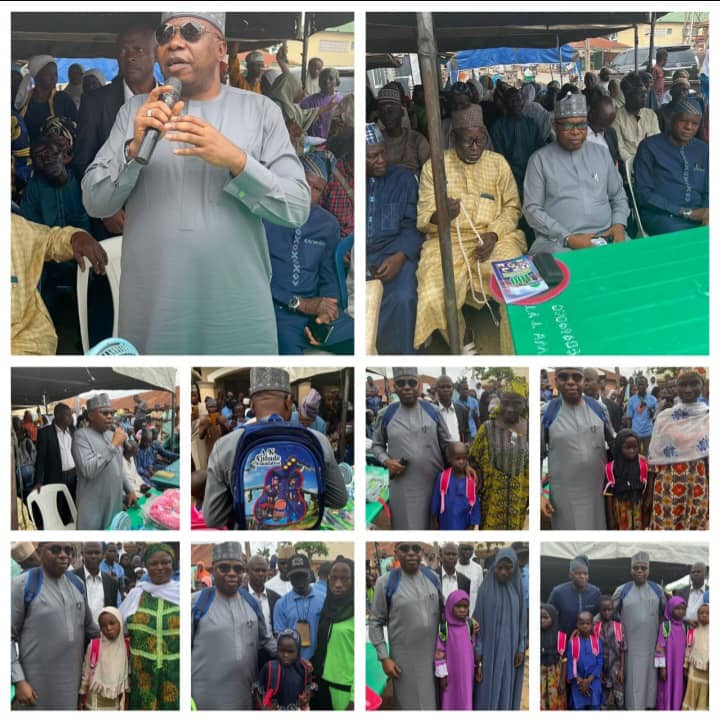
The AK Ajibade Foundation on Saturday, 6th September 2025, concluded the 2025 edition of its annual Summer Lesson Program in Alanamu, Kwara State, with 238 pupils receiving school bags and top-performing students earning cash rewards for academic excellence. The event, held at Pakata zone, Alanamu ward, attracted parents, teachers, community leaders, and political stakeholders, marking what many described as one of the most impactful grassroots educational initiatives in recent years.
The closing ceremony was attended by a large crowd that included Barrister A.K Ajibabde (SAN), the PDP national Legal Adviser; Alhaji Jack, Alanamu Ward Party Chairman; the Ward Woman Leader; and several party loyalists and community elders.
The program, convened by Mr. Bola Abdulkabir and his team of coordinators, showcased the growth of the Foundation’s intervention since its inception in 2024. Organisers explained that while 300 pupils registered this year, 238 completed the program and received rewards.
The highlight of the event was the distribution of school bags to all pupils, a gesture that drew smiles and excitement from children and their parents. In addition, the Foundation recognized academic excellence with cash prizes: ₦10,000 for first position, ₦8,000 for second, and ₦5,000 for third across classes from Primary 1 to Primary 6.
Teachers were also appreciated for their contributions, with each of the six instructors receiving ₦50,000. A total of ₦300,000 was disbursed to acknowledge their role in shaping young minds.
Speaking at the ceremony, Barrister Kamaldeen Adeyemi Ajibade (SAN), Principal of the Foundation, emphasized that education remained central to his vision for community empowerment. “Our goal is simple but ambitious,” he said. “Every child, regardless of background, deserves access to quality learning opportunities. This Summer Lesson Program is one of the ways we are investing in the future of our children and our community.”
Growth of a Grassroots Initiative (Summer Lesson Program)
The Summer Lesson Program was first launched in 2024 with just over 200 students. Its popularity and community trust quickly grew, leading to increased enrollment this year.
For many families in Alanamu, where access to quality educational support is often constrained by economic realities, the program has become more than just holiday tutoring. It represents a bridge between community aspirations and the global commitment to inclusive education.
“The Ajibade Foundation has become a lifeline for many families,” said Alhaji Saliu, a community elder in attendance. “Parents are relieved to see their children engaged during the long holiday, learning in an environment that nurtures both discipline and ambition. This is not just a lesson program, it is a community project.”
For the teachers, the program offered more than monetary appreciation. One of them, Mrs. Adebayo, said the recognition by the Foundation was both encouraging and symbolic. “It is not every day that teachers are remembered in this way,” she remarked. “Teaching during the holidays requires sacrifice, but knowing that our efforts are valued pushes us to give more. The ₦50,000 is helpful, but the real gift is being part of something that changes lives.”
Parents, too, expressed gratitude. Mrs. Rukayat, mother of a Primary 4 pupil, described the program as a blessing. “In this community, many children do not have access to extra lessons because their parents cannot afford it. This program has taken that burden away. My son not only learned but came home every day excited. The school bag he received today is more than a bag — it is pride.”
Among the students, the joy was equally palpable. Eight-year-old Yusuf, who won first position in his class, said the prize money would help him buy books. “I want to be a lawyer like Barrister Ajibade,” he declared, drawing laughter and applause from the audience.
Tying Local Action to Global Goals
Education remains one of Nigeria’s most pressing challenges. According to UNICEF, about 10.2 million Nigerian children are out of school, with socio-economic barriers often limiting access to quality education. In Kwara State, rural and urban gaps persist, with many households struggling to afford supplementary learning resources.
By offering free, structured lessons and incentives, the AK Ajibade Foundation is directly addressing this gap. Its work aligns with Sustainable Development Goal 4 (SDG 4), which seeks to “ensure inclusive and equitable quality education and promote lifelong learning opportunities for all.”
Educational analyst Mr. BolaAbdulKabir, speaking in reaction to the program, noted: “What we see in Alanamu is a localised intervention contributing to a global agenda. SDG 4 is not just about government action; it is about community-led models like this, where private individuals step in to fill critical gaps. The ripple effect is immense — better school readiness, reduced dropout risks, and stronger community cohesion.”
Beyond the Summer Lesson Program, the Ajibade Foundation has supported scholarship schemes, school infrastructure, and vocational initiatives in Kwara State. Barrister Ajibade, who served as Attorney General and Commissioner for Justice in Kwara, has long advocated for youth empowerment through education.
At the ceremony, he reaffirmed his commitment to sustaining and expanding the Summer Lesson initiative. “This is only the beginning,” he told parents. “We are working on expanding the reach of this program to cover more wards, and we are exploring partnerships that will enable us to introduce technology-assisted learning. Education is the most sustainable investment in our children’s future.”
The event drew praise from political stakeholders as well. Alhaji Jack, the Alanamu Ward Party Chairman, commended the Foundation for prioritizing education over politics. “This is what leadership should look like,” he said. “We need more of this type of service-oriented initiative that goes beyond speeches and produces tangible results.”
Similarly, the Ward Woman Leader described the initiative as a “game-changer for mothers.” She explained: “During the long holidays, many mothers worry about their children roaming the streets or engaging in unproductive activities. With this program, we are assured that they are learning and safe.”
Challenges and Opportunities
While the program has recorded remarkable success, organisers acknowledged the need for greater resources. Mr. Bola Abdulkabir, the program coordinator, said sustaining the increasing number of students required scaling up facilities and materials. “We are grateful for the support of the Foundation, but the demand is rising. We see parents coming from nearby wards asking if their children can join. The challenge now is expansion without compromising quality.”
He called for collaboration with government agencies, NGOs, and private donors to build on the gains of the program.
As the sun set on Alanamu at the end of the closing ceremony, the atmosphere was filled with joy and hope. Parents clutched their children’s new school bags, teachers chatted proudly, and students celebrated their prizes. But beyond the day’s festivity, there was a shared understanding that education is the cornerstone of community transformation.
A parent’s voice perhaps captured the sentiment best: “This program is more than a summer lesson. It is a celebration of potential, a reinforcement of values, and proof that when vision meets action, transformation is possible.”
For Alanamu, the Summer Lesson Program has become more than an annual event; it is a movement shaping the future of its children, aligning a local dream with a global promise.