Elena Rybakina’s Season Rocked by Coaching Controversy (2025)
Elena Rybakina’s season has unfolded under a haze of uncertainty, defined as much by off-court controversy as by flashes of her undeniable brilliance. Once seen as the poised successor to the power-driven dominance of the likes of Naomi Osaka, the 25-year-old Kazakhstani has found herself navigating coaching turbulence, uneven form, and renewed questions about her long-term trajectory among tennis’s elite.
The storm began earlier this year when Rybakina’s long-time coach, Stefano Vukov, was provisionally suspended by the WTA following allegations of misconduct. Although Vukov was later cleared to resume limited duties and, in August, reinstated with full accreditation, the episode cast a long shadow over Rybakina’s camp. The WTA declined to disclose details of the investigation, citing confidentiality, but confirmed that the suspension “remained in place” for several months. During this period, Rybakina briefly collaborated with former Wimbledon champion Goran Ivanišević, a partnership that ended after her early exit from the Australian Open.
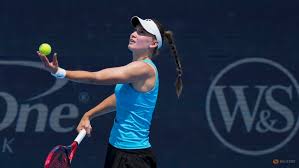
The turbulence around her coaching situation appeared to coincide with inconsistency in her performances. After a convincing early-season run that included a title in Strasbourg, Rybakina faltered at key tournaments, struggling to find rhythm against top-ten opponents. Her defeat to Aryna Sabalenka in the quarter-finals of the Wuhan Open added to a series of frustrating results that contrasted sharply with her dominant 2022-2023 seasons. Yet, in moments, her quality still glimmers. At the Cincinnati Masters, she stunned Sabalenka 6-1, 6-4, displaying the commanding serve and composed shot selection that once made her Wimbledon’s rising force.
Her U.S. Open performance reinforced her resilience. Rybakina dismantled Emma Raducanu in straight sets — a match that drew considerable attention in the UK, not only for Raducanu’s struggles but also for Rybakina’s reminder that her best tennis can still overpower most of the field. She eventually fell in the fourth round, undone by errors and a lack of match sharpness, but the signs of recovery were evident.
Outside the court, Rybakina’s situation reflects a broader pattern of instability within the women’s tour. In recent months, trends surrounding players like Naomi Osaka, Dayana Yastremska, and emerging Czech teenager Tereza Valentová have dominated online searches, illustrating how the WTA’s landscape is increasingly defined by volatility and rapid shifts in form. The Ningbo Open and Wuhan Open have further exposed the gap between established names and the new generation’s unrelenting rise.
In that context, Rybakina occupies an uncertain middle ground. She remains a top-ten player with one of the most feared serves on tour, yet she has struggled to impose the sustained authority that marked her Grand Slam breakthrough. Analysts suggest that the disruption in her coaching setup may have unsettled her preparation routines, though her camp insists the team is “focused and united.” Vukov’s return has sparked mixed reactions — some see it as a step toward restoring stability, while others question whether his controversial reputation could distract from Rybakina’s ambitions.
Her trajectory mirrors that of other contemporary stars wrestling with fluctuating form and public scrutiny. Naomi Osaka’s gradual comeback, Holger Rune’s inconsistency on the ATP circuit, and Yastremska’s attempts to reclaim ranking points all feed into a broader conversation about pressure, performance, and the mental toll of elite tennis. For Rybakina, who has often projected calm detachment in interviews, the challenge lies in translating technical precision into emotional endurance.
In the UK, her matches continue to attract attention not only for the quality of her tennis but also for what her story represents: the delicate balance between talent and turmoil in modern sport. With the WTA’s Asian swing underway and tournaments like the Ningbo Open providing new opportunities for redemption, Rybakina’s next few months could determine whether she remains a fixture in the top echelon or slips into the uncertainty that has claimed so many once-promising contenders.
Her recent victories suggest there is still plenty of fight left. Yet as the season winds down, the question lingers: can Elena Rybakina reclaim the calm dominance that once defined her, or will the noise surrounding her career continue to drown out her game?
Read Also: Ricky Hatton Inquest Confirms Dead by Suicide at 46