China Exports to the US Plunge as Global Trade Realignment Deepens (2025)
China’s exports to the United States fell sharply by 27% in September compared with the same period last year, even as the country’s global exports grew at their fastest pace in six months. The latest figures, released Monday by China’s customs authority, reveal an economy caught between geopolitical headwinds and structural resilience, as shifting trade flows reshape the global marketplace.
Overall, China’s worldwide exports rose 8.3% year-on-year to $328.5 billion, exceeding economists’ expectations and marking a notable improvement over August’s 4.4% growth. Imports also expanded by 7.4%, up from 1.3% in August, reflecting marginal recovery in domestic demand despite a persistent property market slump and slowing consumer spending. Yet, while the headline numbers paint an optimistic picture of external demand, the regional breakdown tells a more complex story of economic divergence and strategic repositioning.
Shipments to the United States have now fallen for six consecutive months, extending a downward trend driven by tariff escalation, political uncertainty, and weakening U.S. demand for Chinese manufactured goods. The latest figures follow a 33% decline in August and illustrate the long-term consequences of Washington’s protectionist measures and export controls aimed at curbing China’s technological advancement. The data arrive at a time when renewed rhetoric from both governments has reignited fears of a prolonged economic decoupling.
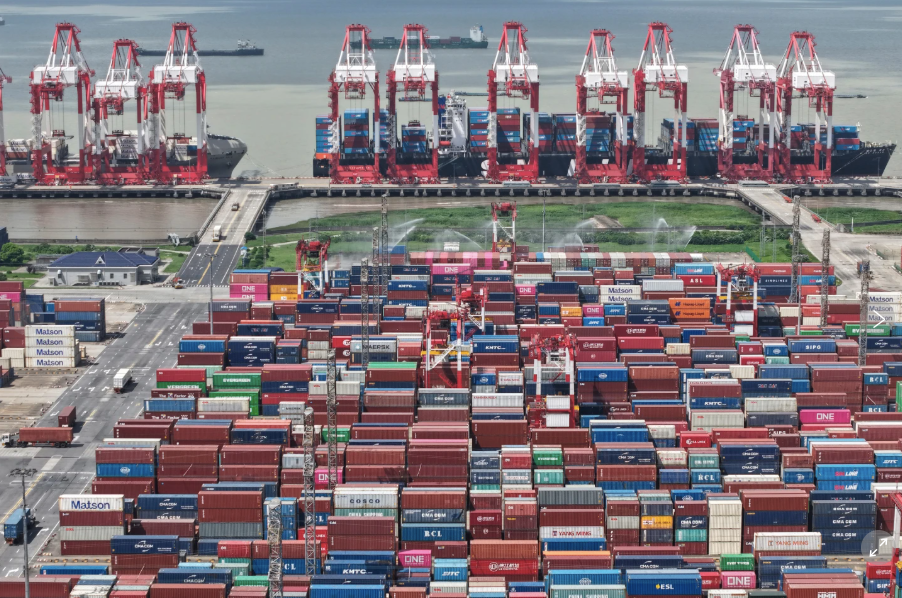
In contrast, China’s trade performance elsewhere shows a clear pivot toward emerging markets. Exports to Southeast Asia grew by 15.6% in September, while shipments to Latin America and Africa rose 15% and 56%, respectively. These figures suggest that Beijing’s export diversification strategy—long in development as a hedge against Western tariffs—is beginning to yield results. Economists note that this expansion reflects both the global competitiveness of Chinese manufacturing and the strengthening of South–South economic ties.
Wang Jun, vice minister of China’s customs agency, acknowledged the challenges ahead but expressed cautious optimism. “The external environment remains severe and complex. Trade faces growing uncertainties and difficulties,” he said during a press briefing in Beijing. “We must continue efforts to stabilize trade in the fourth quarter.” His comments underscore the delicate balance China must strike between sustaining export growth and managing the political tensions that threaten to disrupt global supply chains.
Analysts argue that China’s ability to maintain overall export momentum, despite falling shipments to the U.S., demonstrates the enduring appeal of its low-cost production ecosystem. “China’s exports continue to show resilience given the low costs and limited alternatives globally, despite higher tariffs,” said Gary Ng, senior economist at Natixis. “What is more worrisome is not only tariffs but export controls. If these intensify and disrupt supply chains, the impact could be far more lasting.”
Trade tensions reignited last week after U.S. President Donald Trump threatened to impose an additional 100% tariff on Chinese goods and expand export restrictions on critical technologies. Beijing responded swiftly, announcing new port fees for American vessels and extending export controls on lithium-ion batteries, rare earth minerals, and related technologies. These tit-for-tat measures have deepened unease among global investors and raised questions about the prospects for a long-awaited diplomatic meeting between Trump and Chinese President Xi Jinping scheduled for later this month.
The reemergence of tariff disputes comes amid an already fragile global trade environment marked by inflationary pressures, slow recovery in manufacturing, and a downturn in consumer confidence across major economies. China’s export resilience has, in part, been sustained by its ability to undercut global competitors on price and production scale. However, continued geopolitical frictions threaten to limit access to advanced technologies and foreign markets, which could weigh heavily on the country’s medium-term growth outlook.
The shift in China’s trade dynamics also reflects a broader realignment of global supply chains accelerated by the pandemic and geopolitical rivalries. Many multinational firms have begun diversifying their production networks to mitigate risks associated with dependence on any single manufacturing hub.
Countries in Southeast Asia, such as Vietnam, Malaysia, and Indonesia, have emerged as beneficiaries of this realignment, attracting foreign investment while still maintaining strong trade ties with China through intermediate goods and raw material supply. This trend suggests that rather than a complete decoupling, the global economy may be entering a phase of “re-networking,” in which China remains central but no longer singular.
The implications for global markets are significant. A sustained slowdown in U.S.–China trade could dampen global growth, particularly in economies that rely heavily on exports of intermediate goods to both nations. Meanwhile, China’s growing trade engagement with developing regions could shift the balance of economic influence toward the Global South, reinforcing Beijing’s long-term ambitions under frameworks such as the Belt and Road Initiative.
For now, economists are watching whether the momentum in China’s non-U.S. exports can offset losses from the American market. While the September data offer short-term reassurance, structural challenges persist. Domestic consumption remains weak, foreign investment inflows have slowed, and confidence in China’s real estate sector continues to falter. These internal pressures may eventually constrain the sustainability of export-led growth, especially if global demand weakens further.
The widening gap between China’s global export strength and its dwindling U.S. trade volumes encapsulates the shifting geometry of global commerce. What was once a symbiotic relationship between the world’s two largest economies now appears to be evolving into a competitive coexistence—defined less by integration and more by adaptation. Whether this new equilibrium stabilizes or fractures will depend on the political will of both Beijing and Washington to avoid escalation and preserve the fragile arteries of global trade.
Read Also: Google Chrome Notification Update for Android Users in 2025